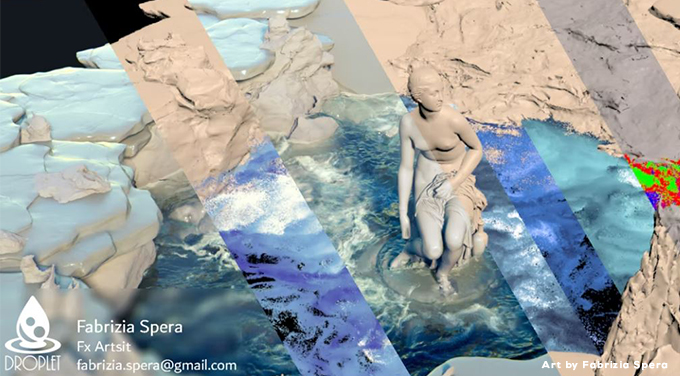
For THE WAY OF SUCCESS column , we meet Fabrizia Spera, FX Lead Artist in Blue Zoo Animation Studio and former 3d Digital Production Master's student.
Hi Fabrizia,
First of all, thank you for agreeing to do this interview. Let's start by asking how did your passion for computer graphics come about and why did you choose Rainbow Academy?
I was about to graduate with a degree in Scenography and thought I would look for a 3D course to broaden my skills and be more competitive. I opened the internet and started looking for some courses in Rome, I didn't do a thorough search, in fact at first I didn't find much. Only after a few days, returning to the internet I was reached by a banner from Rainbow Academy sponsoring a course in 3D and special effects. I forgot everything I was doing and opened it. I knew right away that it was a very interesting course, it really intrigued me, it was very well done, broad, offered many insights and definitely a door to a world unknown to me, but in which I could see myself very much, both professionally and personally. Over the next few days I researched similar schools, to see a bit of what was out there, but No! Rainbow Academy had won me over, gave me the impression that it was not only a school but also a professional training experience, I booked my place for the Open Day. From there, needless to say, I never stopped doing 3D again.
What were your first professional experiences?
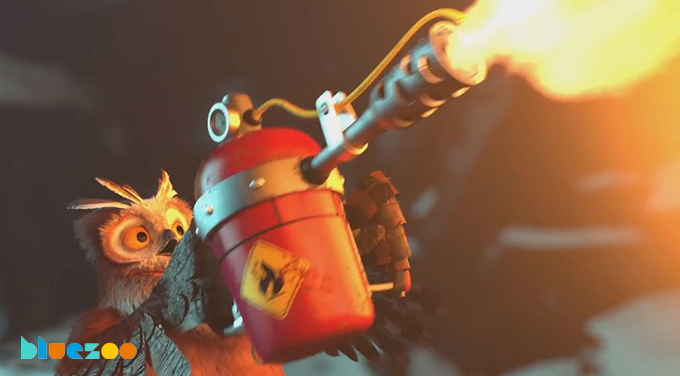
I collaborated with a few filmmakers who, like me, wanted to gain experience, pro-bono. I came across magical asteroids, drawings on the facade of a building and many other projects of a varied nature, where I mainly did FXs, but also general comp, Lighting and more. After this period, I started with Blue Zoo Animation Studio. At the time, they only contacted me for a month, just long enough to do a handful of FX scenes for a video game trailer. I remember the excitement of being there in that studio, finally sitting in a chair that wasn't the one in my kitchen. Ah - and who can forget it! On that occasion I learned an important lesson: I began to look at software no longer as an end, but as a tool to achieve the demands of the art department. In other words, I learned to use technical knowledge in the service of creativity.
What is your current role? Can you describe what you are in charge of and what your responsibilities are?
Putting it very succinctly, I lead my team: this means making sure that the quality, timing and overall product is good and can be presented, on time, to directors or clients. In addition to the aspects purely related to the shots, and thus the technique and artistic aspect on which I give my opinion, I am also responsible for maintaining smooth communication with all the other department heads to agree on methods and ways in which to approach the various moments. Due to the nature of production and especially Fx, we are often faced with new challenges that require so-called brain storming. The latter is one of my favorite activities; I really enjoy seeing how from analyzing a problem, following everyone's thought processes, mathematically we arrive at a solution. Finally, when I can, I enjoy "mentoring," that is, shadowing and helping juniors or entry-level people, interested in special effects, to integrate into the work environment and approach FX in production for the first time.
Of the things you learned in Rainbow Academy, were there elements that proved useful for your career?
One of the things that helped me the most, especially in job placement, was the teaching method, which was very enabling in thinking, not just a recipe for completing a shot. This enabled me to be effective in reasoning and efficient in solutions. They taught me to know the software(s) well, to understand how it "thinks." By understanding the why of things and the underlying motivations, I was then able to initiate critical thinking, which critically, made me choose the best thing to do. In short, it was an 8-month-long reasoning process, and it turned out to be crucial for me especially once I came out of the training context, where the situations I faced were many, the techniques also evolved, but the reasoning remained to guide me in my choices.
Do you have a particular artist you are inspired by in style or technique?
I studied art history for 10 years intensively, between art high school and the Academy, this probably led me to have, not one particular artist, but to have a model of an "ideal artist," in my mind, which is made up of bits and pieces of many artists. I think I judge the end result, whether it is a shot or a painting, by its result "on the canvas," in this case I should say on the frame, by its harmony, its creativity, the beautiful and the ugly that it wanted to represent, and I always try to find the message that the artist wanted to communicate even through the technique. These are cornerstones that I always try to look at and refer back to when I create anything. Style and technique, too, for me are means of getting to communicate a certain thought, in a certain way. Having said that, then, I am inspired by everyone who communicates something, whether it is a big name or a complete stranger.
What projects have you worked on and which of them have given you the most satisfaction as an artist?
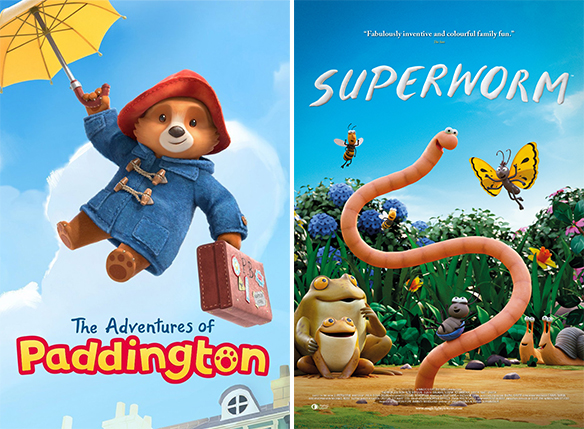
There are two projects that constituted 2 important moments for me. The first is The adventure of Paddington, where, for the first time, we were able to get a style of FX that totally reflects the concept. I was really happy when I saw the sweetness and carelessness of that little bear totally reflected in our renders, with a style that, however, defends the technical and artistic complexity of the effects very well. The second is Superworm, it's a Gruffalo story for children that all of England grew up with. This was BlueZoo's first film and I was delighted with it because really we were able to take care of the smallest details. The best moment, which I will carry in my heart, was inventing a magical FX for a flower that cast spells and hypnotized with its beauty. I believe this is the dream brief for every FX artist, I personally became a child again in creating it.
What are projects you are working on (if you can name them) or upcoming goals you would like to achieve?
None of the projects I'm working on can be mentioned yet, I'm sorry, but we are definitely investing a lot of time in finding new and innovative solutions to astound the audience. Definitely one project in particular has incredible in the sense that it works of a lot of imagination and the FXs also follow this trend. Goals I would like to achieve are definitely to never stop growing, wherever that takes me, I will be happy. I would definitely like to work more consistently with big names in Animation Studios. The dream in the drawer is, not only to make shots, but to devise and make FX Concepts, then integrate more and more technical knowledge and creativity.
What would you never change about your job?
The fact that I never find myself in the same situation, I never get bored! I love being faced with situations that require a good share of problem solving. I like connecting the dots and that there is never just one aspect to keep track of, but always multiple variables. Never forgetting that all this is in the service of creativity, if this side were missing, it would not be the same for me.
If you could send a message to all young people who want to approach this profession, what would you recommend and what would you not recommend?
I have a couple of tips that may help: QUALITY OVER QUANTITY always!!! Do 1 or 2 shots done well instead of 30 done poorly. Don't start with absurdly difficult shots, do simple things well done, those who will watch your showreel know you are juniors and don't expect you to solve simulations or complex problems. As far as this craft is concerned, FX can be intimidating, but I'll let you in on a secret, there is a definite method to approach each simulation and to get started in FX. Like all things there are techniques to be learned and methods to tackle the problem bit by bit. An FX shot may seem like an infinitely tall staircase, but the truth is that it consists of many small steps, which you climb one at a time. For those who want to start on their own as self-taught, but really a bit for everyone, the advice is: analyze your shot before you even begin, ask yourself why things are happening and what the key action is. Don't start out shooting simulations. Understanding the problems you might encounter is key to getting around them. Another little tip: Don't get demoralized if simulations don't come out at first, it is normal to make mistakes in fact, if you make mistakes you are on the right track!!! Do not get caught up in the rush! Observe the mistake, take the time to understand and analyze it. By making mistakes and understanding what is going wrong in that simulation, you will collect in your mind, a database of cases/errors that will blossom like flowers in the future and make you avoid, or even predict, problems. Kind of like when you know the road in your house so well that you know where the potholes are!