April 8, 2021
Intervista a Iacopo Antonelli
Per la rubrica THE WAY OF SUCCESS, incontriamo Iacopo Antonelli, ex studente di Rainbow Academy e oggi Technical Artist presso Rockstar Games.
Hi Iacopo how are you?
Well good! Wait till I put the mask on...ah you don't need it?
Let's start by talking a little bit about your path, your career started early, but you've always been driven by the utmost conviction, yours is a very special story, tell us what started your love for computer graphics and video games?
Of course! So, for as long as I can remember I've loved video games.
I started playing when I was 5 years old with the Game Gear, I only had the Sonic game, but it was just crazy.Then when I was 6 years old I got a Playstation as a gift. And go Metal Gear Solid, Final Fantasy and other titles that I don't need to mention. To me they were incredible worlds, masterpieces of art.
A few years later my mother bought a strange gray box with a keyboard and a mouse: it was love at first sight, like my mother's love for the phone bills that came later...
The first game I played on PC was Heart of Darkness, what a memory.
I started hanging out on various forums where people talked about video games, someone one day said something like "we need a graphic designer" and I impulsively said "I'll do it": (I didn't even know what Photoshop was at 11 years old, but the word graphic designer inspired me).
From there it all started: web design, scripting, one thing led to another, and in high school I found myself studying programming, Adobe software at home, then at 17 I discovered UDK (Unreal Development Kit).
It was a mirage to find out what that software could do.
I bought myself a 1,000-page tome on how to use UDK, then Maya, ZBrush-everything you needed to learn to make a prototype.At some point I noticed that the thing that attracted me most to these software programs was getting more out of what the base offered, working with scripting. I never really took a direction; I always oscillated between math and art, mixing them as I could. I must admit that this caused me quite a few problems in the beginning, but it turned out to be a strength in the future!
When I was a child, video games were a safe haven on many occasions, and that made me want to create them for future generations. So many people find solace in the adventures we create, that in the hands of developers is by no means a power to be underestimated, both in the positive and, of course, the negative effects.
You have been for a long time one of the artistic and technical focal points of Indiegala, the company that later also gave many Rainbow Academy students the opportunity to make their dreams come true. What can you tell us about this experience?
Working for Indiegala was crazy, looking back on it today.
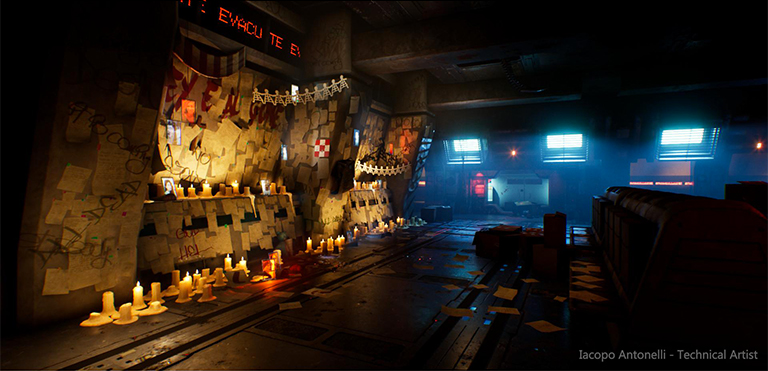
Ups and downs, of course, as in any company, but it's mainly because of that experience that I got here.It gave me the opportunity to work on two incredible projects and with incredible people. The first one was Blockstorm, developed with the Roman team Ghostshark since 2013, then came Die Young with Indiegala's internal team, I think I'm not wrong to call it the first all-Italian Open World made in Unreal Engine 4. The environment was always very stimulating, all the people I worked with had a deep passion for video games and there was a not inconsiderable attention to detail.
I don't want to make it sound all rosy though, working on an Open World of that caliber with a team of only 10 people was quite a feat, but at the same time it's incredibly challenging to be so few of us facing such a giant. There wasn't the UE4 support on the Internet that there is now, so almost every problem related to the engine didn't have a solution at hand, and that led to all of us having to do a lot of problem solving. I would advise anyone to start with an indie company, for two reasons mainly. The first is that indie companies offer experiences that triple-A companies sometimes do not (and vice versa, of course). The second is that you don't know what the right environment is for you, sometimes indie and triple A can be very different.
However, if I talk about Indiegala, I cannot fail to mention two of my former colleagues and former Rainbox students who worked with me at Die Young: the legendary Paolo Pallucchi and "the irreproachable" Claudio Rapuano!
You currently work for one of the world's most important companies in the video game industry. You also had another fantastic experience in a super company like Ubisoft. From an indie reality to such big, structured companies-you were catapulted into completely different realities, but you had strength and determination. What was the transition like?
Yeah! To be honest, the transition wasn't that traumatic.
Of course, you find yourself changing from a team of 10 people to a team of 600, it's a crazy change of scenery and you have to change the way you work, if you don't have an aptitude for working in a team you won't get far. Ego has to be left at home.Anyway, it was amazing to find out how things are actually not so profoundly different at the team level. Even being in a team of 600 people, depending on the role you generally find yourself working closely with more or less 50 to 60 of them, which are not such different numbers from an indie reality, except that you feel the project (for obvious reasons) is a little less "your own." You find yourself no longer able to make decisions just by asking your close colleagues, there are completely different and very branched hierarchies, and it takes a while to figure out who to ask: I remember once being bounced about 5/6 times before I got to the person I needed to talk to.
Holding the role of Technical Artist, I found myself working continuously with more or less 100 people in the core team, and sporadically with another 200, also scattered in other studios.
At some point you have to remember what each of these does, inform her if you make substantial changes to her work, and so on. The trick to not going crazy? As Bruce Lee says: be water 😉
Your role is very unique, would you like to explain more about what a Technical Artist is about?
Of course!
In summary: What gives more satisfaction than bringing a smile to the face of a struggling artist/animator/designer/programmer?
All kidding aside, the role of Technical Artist varies from company to company and is not really always black and white.
Usually a Technical Artist comes out of someone who has a mix of experience and has a passion to get their hands in different areas, as mentioned before I have always had a passion for both graphic design and technical and math.
My first experience was already a rather strange role, I worked on this prototype with Unity and Maya for Crisma (a Roman company) that was to be used to visit the RHO fair in Milan virtually.
Already there I was doing both the code and the art, generating the environment procedurally on Unity via coordinates provided in XML.
After Crisma came Indiegala, I worked as a C# Programmer on Blockstorm using Unity 3D, mainly dealing with the game UI, always graphics and code. My approach with shaders started in Unity, but developed in Unreal Engine 4.
I was really fascinated by the node-based Material Editor, and it was much easier for me to understand how everything worked by always being able to look at a preview, both of the end result and of each node.
On Die Young I worked on shaders, scripts and environments (creation and optimization) and it was like a kick start.Usually a TA does not create environments, but I used to work at Indiegala as an Environment Artist, I became the TA of the studio more out of general necessity and inertia. In Ubisoft (The Division 2) I found myself working mainly on the graphics of the main missions: creating "exotic" shaders, optimization and profiling, technical decisions on world/mission creation, scripting for procedural generations or for technical analysis, creating interactive game elements, and problem solving on whatever happened to be solved.
At Rockstar I do pretty much everything else, working mainly in the area of developing tools for the animation and audio industry.
It's a little difficult to define precisely what a Technical Artist is, but I can safely tell you that it starts with scripting, shaders, and problem solving. TAs are the wild cards in the studio and are able to work in different departments, in fact they are the glue that holds all the departments in the studio together.If you want you can specialize, usually you choose between shading, scripting or animation, but often these three elements merge. I remember when once, in one of my first work experiences in Italy, someone told me "you can't be a graphic designer and a programmer, you have to choose": well, that wasn't true, fortunately.
A Technical Artist is a person who has a penchant for both the technical and artistic side (more for the technical side). I have never excelled as an artist, but what a Technical Artist accomplishes allows the artist to take the result much higher. The image below illustrates which figures relate to a TA and in what areas they usually work:
What do you think is the difficulty a Technical Artist most frequently encounters and the main differences, if any, with other departments?
A Technical Artist receives technical questions from every department: animation, art, design, programming--most often related to a technical problem to be solved.
The TA is the figure in a game studio who has a crystal clear view of how everything works and how to put the pieces together, both to solve problems and to create new technologies and raise the graphical quality of the product.
Trivial example: 3 months to game delivery, you realize that memory is not enough because too many meshes/textures have been placed in the game. If you're lucky, a TA will have already written a game world analysis system of his own months in advance, and the skimming job will take a couple of weeks, perhaps even automatically.
As I said before, the role changes slightly from company to company and consequently the difficulties vary. At Ubisoft for example, the Technical Artists have some decision-making power over what goes into graphics, and the main problem there is also holding up the pressure of an entire Art Team when it comes time to say "No, this can't be done or the console explodes," taking dirty looks and tomatoes.
The Technical Artist is also this.
In your opinion, what characteristics and skills does a Technical Artist need to have, artistically and technically?
On an artistic level, I think you have to have a good eye for what is beautiful.
At the technical level it is a different story. If you work in shaders, you must have mathematical knowledge necessary to be able to implement sometimes very complex equations, or know how a GPU works even in relation to the other elements of a system.
If you work in animation, you will have other technical knowledge, mainly scripting and animation, but still it always comes down to math in the end, it's inevitable.
Another skill that a TA absolutely must have is problem solving, being able to break down a giant problem into many small problems and arrive at a solution step by step.
By now you have a fairly broad view of the videogames industry, what do you think are the most important difficulties and differences between Italian companies with international companies in the industry? Do you think there is really a prospect for growth in Italy?
In Italy there is definitely growth at the level of societies, new ones are being born and existing ones are growing more and more.
When I started, in 2012/2013, there was not a single job proposal in video games in Rome, today it is different, there are more realities, more offers.
Certainly the prospect of growth is very different for someone working in an indie team than for someone working in a larger team abroad.
One of the main differences I have noticed between Italian companies and foreign companies is that in Italy there is a tendency to hire one ninja to do the work of 10 people, rather than hiring 10.
It is not a logic I condemn, I think it is inevitably part of the development of an industry and it will change: in fact, it is already changing.
What are the latest projects you have been working on and what are the future ones if they can be mentioned?
For the past two years I have been working on various VR projects as a freelancer, The Division 2 for Ubisoft and a pinch of Red Dead Redemption 2 PC version for Rockstar.
The rest will be discovered!
What was the project you were most attached to and that brought you the most satisfaction?
I am torn between Die Young and The Division 2, but I will choose the latter.
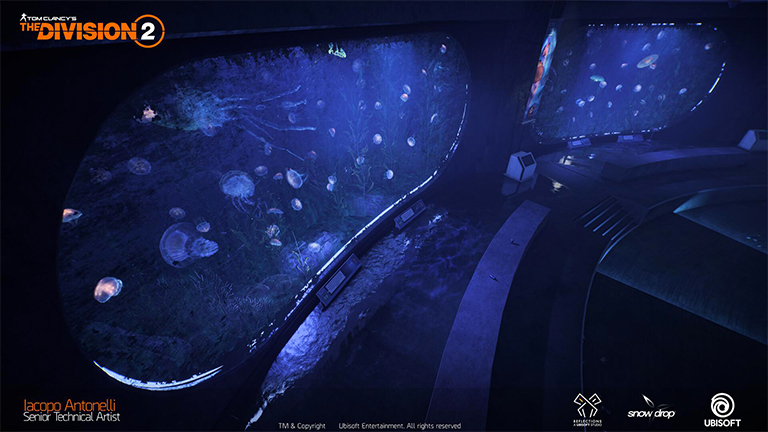
The reason is that I am very proud of the fact that a scene to which I devoted my heart and soul was also shown on the E3 2019 stage!
Making that aquarium took almost three months, including all the work I did with the animators and artists to get the final result.
I still have the notebook with the drawings and equations!
If you had to give advice to young people who would like to approach the profession, what would you recommend and, in your opinion, what are the most common mistakes for those approaching the industry for the first time?
Stock up on humility and sense of sacrifice in packs! Everyone can teach you something; you must start by thinking that you know nothing.
Even after years in industry, one continues to learn.
Most societies reward error and condemn know-nothingness.
I myself have made this mistake.When I started I thought I knew them all, but the more I learned, the more I realized I didn't know anything, and that allowed me to learn even more. I was also lucky to work with really strong people.
Ringraziamo Iacopo Antonelli per questa intervista!
Thank you!!! I was very pleased 🙂