March 18, 2021
Intervista a Paolo Pallucchi
For the column THE WAY OF SUCCESS we meet Paolo Pallucchi, Game Artist.
Hi Paolo,
let's start by doing a little introduction: you have always been hyper passionate about video games and you started your career though doing something else. What were you involved in?
Hi. Before starting Rainbow Academy I was working with my father at a regional TV station in Lazio (Super3) as a technical helper. It wasn't really my field, I was getting by but I didn't feel any stimulus in what I was doing. After a few years I decided to offer myself as a graphic designer and, with the help of some online tutorials, I managed to create a department that was previously absent in the station: compositing and motion graphics. I was in charge of graphics for program theme songs and commercials using After Effects and Photoshop.
It was already a great satisfaction for me, until in 2013 the station was forced to close. I thus found myself having to start over at the age of 28. I decided to take a group of friends and try to make use of what I had learned during my 6 years of work and try to shoot a short film with the few means I had. The result at the time didn't seem bad to me, but the moment I had to collide with reality was when I had to create a 3d character and animate it by implementing it in the video.
Following online tutorials seemed like an "easy" thing to do. After weeks of trying, I realized that I could not rely on tutorials alone, but needed real instruction. More than knowing how to do things, I wanted to understand them. I wanted to be sure of what I was doing without the step-by-step guidance of the youtuber on duty. By pure chance a few months later I came across the Rainbow Academy booth at Romics. So I decided to use all the money I had saved and make the investment that turned my life around.
Your ball though has always been something else right? How did you approach computer graphics?
I have actually been playing video games since 1990. I was 5 years old and I remember that I was already at that time fascinated by the aesthetics of video games. Besides the aesthetics though, I was crazy about those video games that managed to have a narrative (my favorite was Another World). Later games also used CG for intermetto footage, which at the time I called "The footage with the beautiful graphics." I understood that with video games and with CG footage one could tell stories, characterize characters, and make the viewer/videogame player feel emotions. So let's say that I saw CG as a potential expressive medium (besides logically a medium for entertainment).
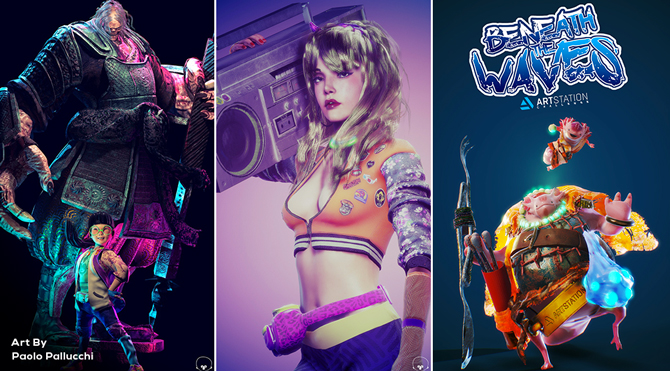
Your career started with full cg animation, then there was the turning point and the transition to video games, what was that like?
Let's say that already with CG I was satisfied. But never did I expect that all the hours spent on video games would come in so handy that my greatest passion would become my current job. It was initially a somewhat disorienting transition. There are so many things in common but so many totally different things but all the basics are pretty much the same.
You currently work for one of the most promising indie companies in the video game industry, IndieGala. You faced a magnificent challenge with Die Young, how does it feel to make a video game by building and curating every single artistic part of it?
Feeling part of a team is a good thing. Especially in a small indie team. Besides publishing a product made with our own hands, we all became a little closer (and better). It was a very tough challenge and the first moment we published for me was terrifying. We are a small team so we are self-managing and the only people who tell us if a work is going well or not is the audience. Everything is unknown until it goes into the hands of the buyers. Fortunately, in the end they liked the game and I still can hardly believe I made it.
The first time I saw my Steam models and artwork was exciting, but the thing that personally satisfies me the most is going to the user screenshots section and seeing that there are people who have screenshotted some of my work. [even if they sometimes screenshot glitches or various bugs 😀 ]
Many people do not know the difference between a Game Artist and a modeler or texture artist for full cg or visual effects. What are the differences especially in job management?
From personal experience I can explain the substantial difference there is in modeling characters for CG and for video games. Handling the work as far as a character for video games/realtime engines is the constant awareness of the number of triangles in it, how many textures it has, the resolution of those textures, and how many bones the rig has.
Realtime is making great strides and qualitatively speaking it is getting very close to computer graphics, but to make everything run smoothly there is a need for optimization so that it does not become too heavy. It may seem like a limitation but I assure you that after a while you get the hang of it. Being able to achieve high quality through optimization "tricks" is a rewarding thing. This is exactly why I would like to remind you that - when you see a 3d work on some social or on Artstation - always try to understand if it is a work for realtime or for CG. They may have a very similar aesthetic result, but the challenge to achieve it is different.
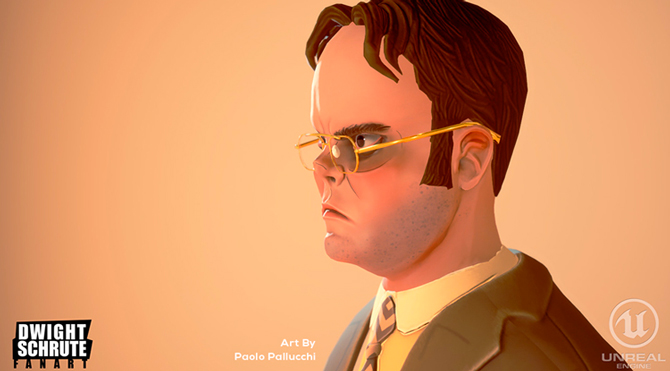
What do you think is the difficulty most frequently encountered by an Asset Artist?
First, I think the difficulties change whether the work is on commission or for a personal project. In the case of the commission it may happen to have no reference at all but a simple written description. One of the most difficult things is to create a workflow such that you can change the asset in any area with minimal effort. It happened to me almost constantly that I had to put my hand back on a character model with finished rigs and animations. The first few times were a disaster but then I realized that order and reasoning about the various steps is essential. It will happen very often then that deadlines vary and a temporary model needs to become final as soon as possible. If you have organized everything to the best of your ability you will have already done 50 percent of the work.
Personal projects also offer a good challenge but with yourself. It may seem simple because you are the one calling the shots, but you will at some point realize that the "flame" has gone out. You will no longer have any motivation to continue and it will seem like pointless work. This happens when you are proceeding in a cumbersome way. Without fun. This is why the first piece of advice I give to people who want to start a personal project is to set yourself as a goal by asking yourself questions such as, "How do you shape your hair? I don't know. Okay, let's design a character with the main feature based on hair." This way, in addition to publishing new work, you will also have learned new things.
In addition to creating assets for your company, you are also very productive and work a lot on your own personal projects and also participate very often in international contests. You are a flood of creativity and experimentation, you like to range a lot between styles. However, is there an artist or video game you are inspired by or have been inspired by?
My favorite artist is Oleg Vdovenko. I have seen how he works and I really admire his "personal" workflow. He manages to recreate what is in his head by mixing techniques and styles creating an absurd mood. Among the realtime artists I admire most, on the other hand, is Georgian Avasilcutei. His work is very clean and I find the quality of his models to be at a very high level. Technically monstrous. For my personal style, however, I think it is something born with time.
Before doing 3d I used to enjoy creating 2D characters. Among my influences for sure are many manwha (Korean comics) including Bal Jak from which I learned the power of the eyes and postures of the characters while at the video game level I am quite influenced by all the titles that manage to characterize the characters in an original way, for example: Team Fortress 2, Half Life, Overwatch, The Last Of Us, Uncharted, DMC, Enslaved and Hellblade (but I could mention many others).
When you think of a project to carry out, what do you let guide you?
Besides music I would say from a desire to learn and experiment with something new or that interests me. Each of my personal works has behind it a study of something I didn't know how to do before. I have works that I never published and that I never published because they didn't really stimulate me anymore. I wasn't learning anything and continued them out of inertia. Once I finished I didn't have the courage to post them precisely because they seemed "useless".So yes, let's say that what drives me is curiosity and the desire to learn and to prove to myself that: "Hey, you made this! YOU CAN DO STUFF!"

Very important in the making of your presentations is the music, does it inspire you or do you make the characters first and then think about the music?
My characters always come from music. I spend a lot of time alone and always listen to music without lyrics [Lyrics influence my inspiration too much]. Ambient, retro wave, aesthetic, classical or electronic music. Depending on the mood of the song I try to imagine a hypothetical character, his story, his world and his goal. The aesthetic then arises automatically.It happened to me once that social media blocked one of my works because of copyrighted music (Mea culpa). I then found another song that broadly reflected the mood of the character. Unfortunately, however, my head did not see character and music fitting together perfectly so I modified the character to make it fit. This is to say how important it is to me that the music, movements, looks and aesthetics of the character should almost be one.
In your opinion, what characteristic should a 3D Artist never lack, artistically, technically, and humanly?
At the artistic level one key thing is not to be too proud. Personally if I get a little criticism - well targeted - I might self-destruct but, if you can understand what you did wrong you can improve. And in future projects you will see the result. Also, it is essential that you always study by observing.When you see a character for example charismatic, try to understand why they are charismatic. Look at the eyes, the pose, the framing and many other small details. Although music is essential for me to communicate the mood 100 percent, a character that works can work without it. It is precisely because of these details.
Another important thing is to pay close attention to proportions. A character may have a huge head, feet or arms. But they will always have to respect some kind of balance with the rest of the body. And how can you tell? By observing other styles. Observe and understand. It's crucial!
On a human level I think everything they taught me in Rainbow Academy applies: "Don't keep things to yourself. Share them. "Our industry-video games or CG-is a wonderful industry and can only grow if those who work in it grow. If you are that cog that keeps things to yourself, you will not be the misunderstood geniuses, you will be the one who thinks he is the only one in the world who thinks he has figured out "The Easy Trick" when in fact he has not. You will be self-isolating. So the key thing is to help.Another good thing is a good dose of competitiveness. But not the obnoxious one, the one that will make you say inside your head, 'Now I'll show you the cool model! ' It will be a good motivator. On a technical level, curiosity and fun. It will seem obvious but if you are not curious you will fall behind. And if you are curious without fun, it becomes a forced thing and you will struggle immensely. These are things that can be cultivated but it takes some sacrifice. For example, I initially hated UV. With my whole self. Until I decided I wanted to learn how to do them properly. There, after a while of doing them, I swear to you, I started to enjoy it. And do you know when I started to have fun? When I started to understand the method. Try to avoid like the plague those who tell you, "There's the script that does UV on its own." Because a job done by head will never be like a job done with "the script" intended as a shortcut for lazy people.
What are the latest projects you have been working on and what are the future ones if they can be mentioned?
Currently at the working level we are in the pre-production stage of a new video game. We are still the "small team" but with a lot more experience! I am curious to see what we will be able to do! While at personal projects I am working on a character that can allow me to study cloth dynamics in realtime. We will see what will come out!
What do you dream for your future?
Being able to create my own video game. Telling a story by bringing it to life for video gamers I think is one of the things that would help me the most on a "communication" level. I love the art of communication, and I think video games are currently the medium that does that best.